
When you order a tennis racket from a marketplace or a discount site, you receive it, and something feels off. The grip smells like cheap plastic, the logo seems slightly misaligned, and the frame appears lighter than expected. Spotting a fake tennis racket before hitting the first ball avoids a nasty surprise on the court, and sometimes a risk of injury due to a fragile frame.
Checking the serial number and QR code on a tennis racket
Before even visually inspecting the frame, you start with the serial number. Major tennis brands have set up online verification systems by serial number or QR code. Each authentic product has a unique code that can be traced directly on the manufacturer’s website.
Specifically, you scan the QR code located inside the throat of the racket or on the handle label. The official site then provides a confirmation of authenticity, or nothing at all if the code is fake. An unrecognized code by the manufacturer’s site almost always indicates a counterfeit.
You should also check the consistency between the serial code and the distribution country. A racket sold in France with a code intended for the Asian market may be a diverted product or a copy. You can discover tips from Mordu de Sport to delve deeper into this serial number verification step.
Some recent counterfeits include a fake QR code that redirects to a site mimicking the brand’s. You check the URL in the browser’s address bar: it must exactly match the official manufacturer’s domain, with no spelling variations or unusual extensions.
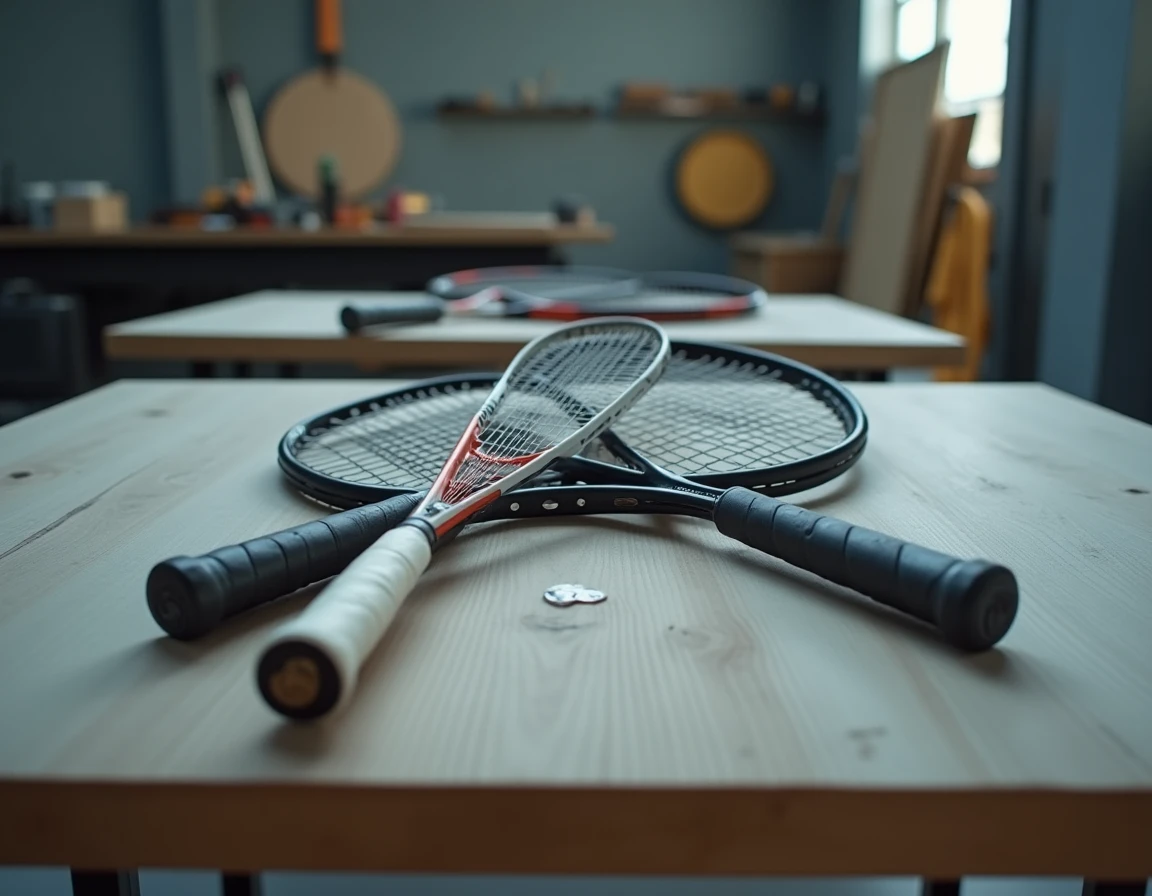
Frame quality and visual finishes: the details that betray a counterfeit
Recent counterfeits are increasingly mimicking the weight and balance of an authentic racket. The area where they fail remains the finish. You turn the racket under direct light and inspect three specific areas.
The varnish and paint of the frame
On an authentic racket, the varnish is uniform, with no runs or micro-bubbles. A counterfeit often shows texture irregularities to the touch, especially at the throat (the area between the head and the handle). A gritty varnish or paint marks that overflow onto the handle are common signals.
Logos and inscriptions on the racket
You look at the sharpness of the logos and the alignment of the inscriptions. Brands publish guides detailing the exact shape and position of the logo on the handle, the specific typography of the serial code, and even the spacing between characters. These guides are regularly updated to keep up with the evolution of copies.
An irregularly edged logo, blurry or misaligned prints are major signals. On some brands, the font used for the model name subtly differs between the original and the copy, sometimes just a simple serif or modified spacing.
The grommets and string pattern
The grommets of an authentic racket are regular, well-seated, with no plastic burrs. On a counterfeit, you may find misaligned grommets or a different number of string holes than the official model. Comparing the string pattern with the manufacturer’s specifications takes two minutes and can clear up doubts.
Price and purchase channel: warning signals before ordering
The first filter remains the price. A tennis racket sold significantly below the price practiced by authorized retailers deserves caution, even if the seller displays a convincing photo. Some recent counterfeits are sold at a price close to new to appear credible, which complicates spotting them by price alone.
You should prioritize official distribution channels: brand website, identifiable authorized retailers, specialized stores. On marketplaces, check the seller’s profile, their history, and the announced origin of the product.
- A seller without a history or with generic reviews on various products (electronics, clothing, rackets) is a warning signal
- The absence of an official invoice or manufacturer’s warranty accompanying the racket should raise alarms
- A package without a precise model reference, without a compliance label, or without mention of the country of manufacture increases doubt
Cross-referencing multiple indicators rather than relying on a single criterion remains the most reliable method. Brands and distributors explicitly recommend this approach, as no isolated sign is sufficient to make a decision.

Test in hand: what the game reveals about the authenticity of a racket
If you already have the racket in hand, the field provides information that visual inspection does not. A counterfeit often reveals itself through unusual vibrations upon impact and a hollow or metallic sound upon contact with the ball, where a quality graphite frame produces a dull and absorbing sound.
The tension retention of the strings on a fake racket drops abnormally fast. An experienced stringer also spots anomalies during setup: grommets that do not accept the usual string, a frame that flexes under standard tension, or a head that slightly deforms once the string is in place.
Feedback varies on this point, as some high-end copies pass the visual test without difficulty. A visit to a stringer or specialized retailer who handles authentic frames daily remains the ultimate check.
- Weigh the unstrung racket and compare it to the weight announced by the manufacturer (available on the official site)
- Check the balance by placing the frame on a finger at the theoretical balance point
- Have the racket strung by a professional who can assess the rigidity of the frame during setup
The market for counterfeit tennis rackets is evolving rapidly, and copies are gaining quality each year. Buying from an authorized retailer remains the most direct protection. For a second-hand racket, combining serial number verification, finish inspection, and hands-on testing covers the vast majority of risks.