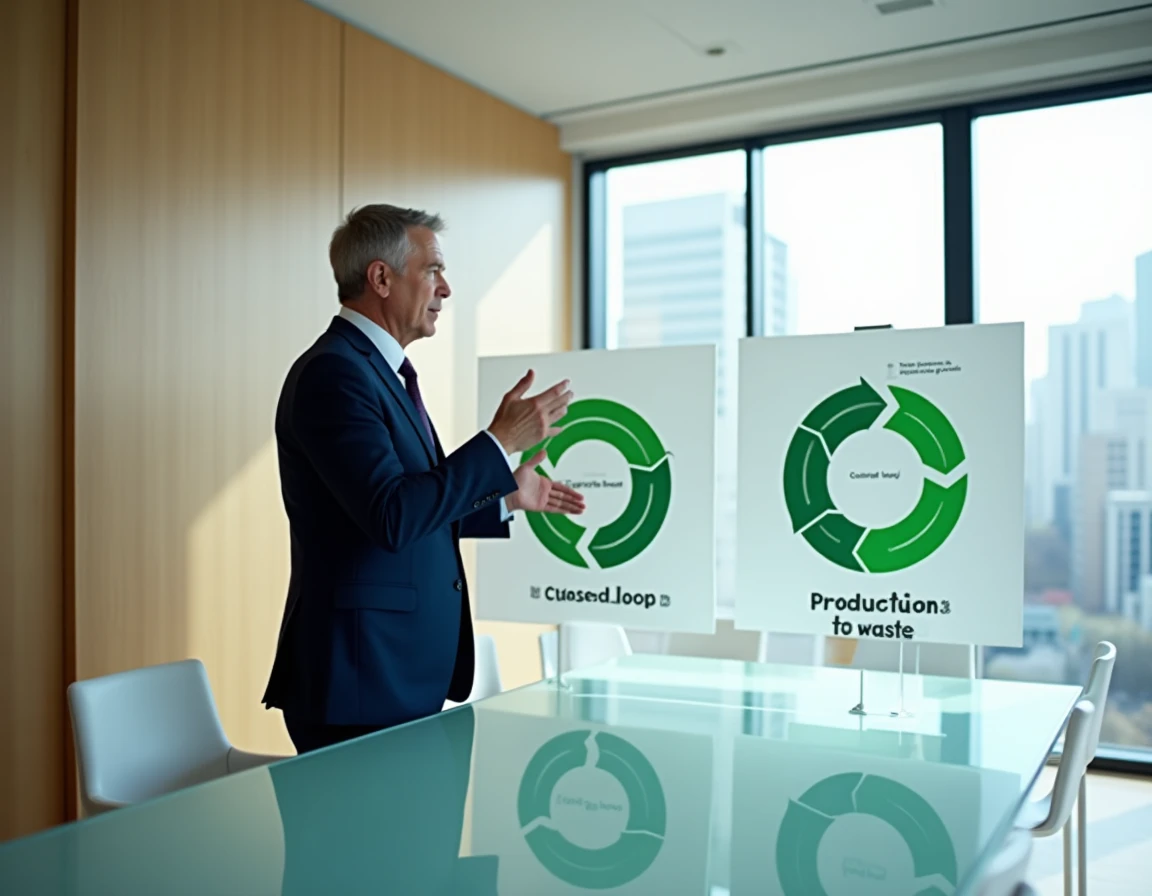
The circular economy refers to a system of production and consumption where materials remain in a loop for as long as possible, through reuse, repair, or recycling. In contrast, the linear economy follows a single path: extraction, manufacturing, use, and landfill. This distinction, long confined to environmental policies, now shapes concrete investment decisions, notably through European regulations and the emergence of dedicated thematic funds.
Material flows and value creation: what the loop changes
In a linear model, the value of a product decreases irreversibly after its first use. Extracted raw materials pass through the production chain only once before becoming waste. The real cost of this journey includes extraction, transport, processing, and then end-of-life treatment.
The circular economy intervenes at every stage to slow down or reverse this loss of value. Eco-design extends the lifespan of products. Refurbishment gives them a second cycle of use. Advanced recycling recovers materials that reintegrate into manufacturing.
The fundamental difference does not lie in recycling alone. It lies in the economic logic: maintaining the value of resources in the system rather than destroying it. For an investor, this translates into companies whose revenue model is based on product durability or the resale of secondary materials, rather than accelerated renewal.
Understanding the differences between circular and linear economy allows for a better assessment of the resilience of an economic model in the face of resource scarcity and tightening regulations.

SFDR Regulation and European Taxonomy: Circularity as a Financial Criterion
The SFDR regulation (EU 2019/2088) has transformed circularity into a formal sustainability criterion for financial products. Before this text, a fund could claim to be “green” without specifying its objectives. Since its entry into force, managers must classify their products according to their level of environmental ambition.
Funds classified as article 9 SFDR explicitly aim for a sustainable investment objective. Several of them now target companies contributing to the transition to a circular economy: eco-design, second-hand platforms, advanced recycling, industrial reuse.
The European taxonomy complements this framework by defining which economic activities can be considered sustainable. The transition to a circular economy is among the recognized environmental objectives. For companies, this means that their circular practices directly influence their eligibility for green financing and their attractiveness to institutional investors.
What this changes for a portfolio
An investor analyzing a thematic fund must check whether the SFDR classification is based on measurable circularity criteria or just a generic environmental label. The distinction between article 8 (promotion of environmental characteristics) and article 9 (sustainable objective) alters the actual composition of the portfolio.
An article 9 fund dedicated to the circular economy invests in concrete solutions, not in companies that merely reduce their emissions marginally. This regulatory granularity is recent, and not all financial products yet incorporate it with the same rigor.
Circular economy investment funds: an asset class in development
In recent years, several managers such as Robeco, NN IP, BNP Paribas AM, or BlackRock have launched thematic funds explicitly dedicated to the circular economy. The Robeco Circular Economy fund, for example, positions itself as an actively managed fund aiming for sustainable investment as defined by article 9 of the SFDR regulation, financing solutions that support the transition to a circular economy.
These funds invest in companies aligned with several pillars:
- Eco-design of products designed to be repaired, disassembled, or recycled at the end of their life, reducing dependence on virgin raw materials
- Reuse and second-hand platforms, which extend the lifespan of goods and generate recurring revenue on the same product
- Advanced recycling and the production of secondary materials, which reintegrate resources into the manufacturing cycle at lower energy costs
This structuring creates a distinct investment segment from general environmental approaches. A “climate” fund and a “circular economy” fund do not target the same companies, even if their universes may partially overlap.
Evaluating a circular investment: the criteria that matter
The “circular” label is not enough to qualify the solidity of an investment. Several elements allow for distinguishing a company genuinely committed to this model from one that uses the term for communication purposes.
- The share of revenue generated by circular activities (repair, rental, resale of materials) compared to traditional linear activities
- The integration of eco-design from the product development phase, verifiable through certifications or measurable commitments
- The traceability of secondary raw materials used in manufacturing, which reduces exposure to supply chain tensions
- Alignment with the European taxonomy on the objective of transitioning to a circular economy
Companies whose model depends on the rapid obsolescence of products are structurally exposed to tightening regulations and changing consumer behaviors. In contrast, those that derive their revenue from the longevity of goods or waste valorization position themselves on a converging regulatory and market trend.

The boundary between linear and circular economy is not binary. Most companies fall somewhere on a spectrum, with more or less advanced practices depending on their business segments. For an investor, the challenge is to measure the speed and credibility of this transition, not to classify companies into two airtight boxes.